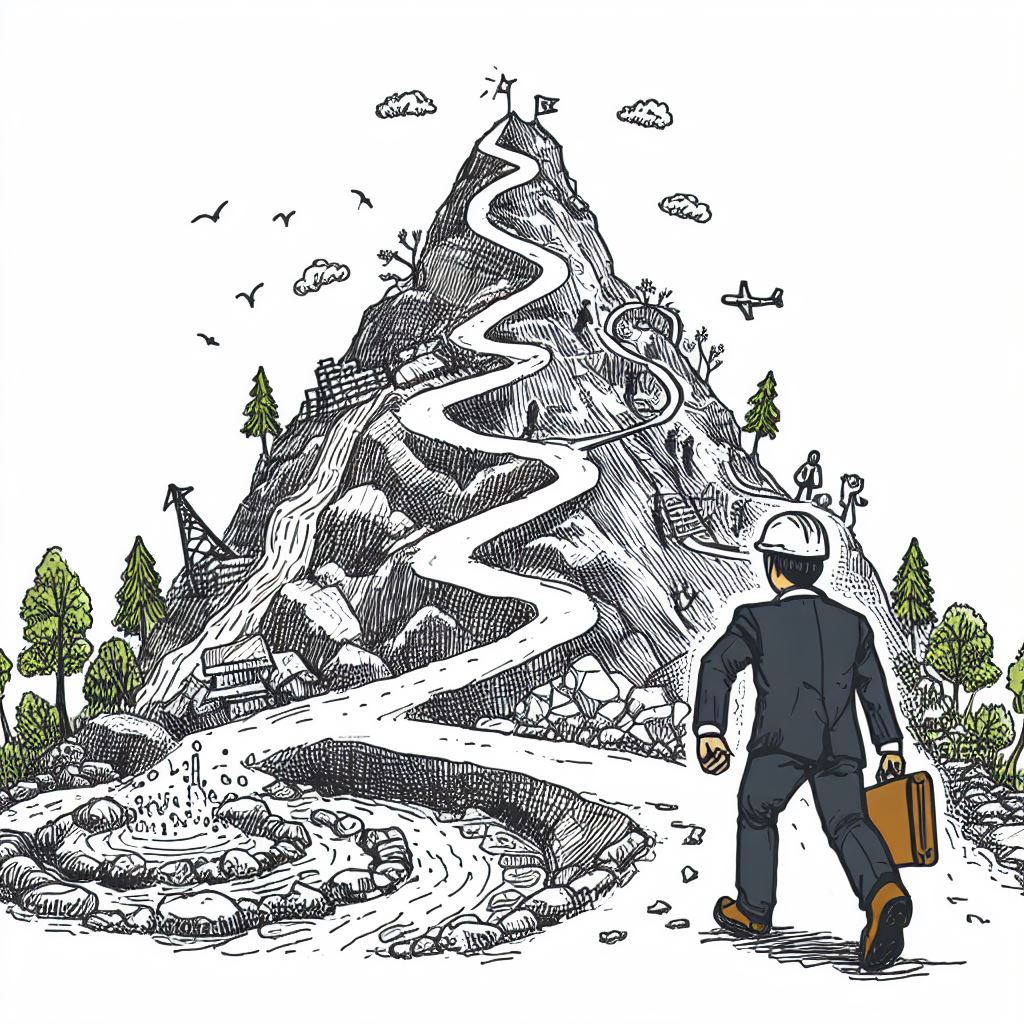
The biggest mistake that you can make is to believe that you are working for somebody else. Job security is gone. The driving force of a career must come from the individual. Remember: Jobs are owned by the company, you own your career! ~ Earl Nightingale
Recently I was told about a conversation two colleagues were having. And it’s one that I’ve heard many times before. Someone tells you that they are following the path another person took to a particular position. It’s easy to think this way, particularly if someone is struggling to find their way to what they see as the next step on their career ladder.
This leads to some unfortunate thinking. You start thinking that there is a singular defined pathway to the next position. That there are certain things you have to do, or certain people that you need to know in order to get that next gig. And you think this way because you think there is a secret code to get into the club. So you pick someone who you think resembles you, perhaps faces the same challenges you perceive you have and use their path as a model because they obviously cracked the secret code. I get how attractive this thinking can be, and why so many people go down this road.
But it’s fundamentally flawed for two reasons. First, there is no secret code, sure there are absolutely biases in hiring. But particularly in the California Community College system, many of these biases have been reduced in the last twenty years. When I first came to my current college, the president and every vice-president at the institution were women of color. So while I’m not naive enough to think there are no biases, things are certainly better than they were twenty years ago. The second issue is that there is no one path to any particular leadership position.
I know deans who have not been tenured faculty (I’m one of them), I know deans who have never been classroom instructors. And the same can be said for vice-presidents and presidents. Where once there seemed to be a single path, tenured faculty, get an EDD or PhD, dean, vice-president then president. That is no longer the case. There are college presidents who have come from other systems and even from industry. I know of several presidents with law degrees or MBA’s instead of the standard doctoral degree. And in fact I’m quite sure somewhere in the California Community College system there is at least one and likely more, who only have a master’s degree in their discipline.
Presidents can come from both the academic and student services sides of the house. Some presidents have also come via the research or finance pathway. So the idea of a single pathway just doesn’t make sense anymore and as such, trying to follow that “right” path is not a great career strategy.
I believe that this type of thinking comes from a primary error many people make in thinking about a career in higher education. They focus far too much on getting to a particular position. They think that there are check boxes one must complete in order to be qualified for each step on that pathway. So often they believe, I need to have teaching experience, I have to complete a certain level of Diversity, Equity and Inclusion experience. I need to make sure I have some sort of online teaching credential. I had better serve on the finance committee at the college and participate in some sort of administrative or executive training. All of these things are great experiences to have, but if you’re doing these things not because you have an interest in them, but because you think you should, you’re just checking off boxes.
These days I see far too many administrators who have checked off all of the boxes. They drop whatever topic or term is hot at the moment. These are the people who say equity ten times in every discussion, but when you get down to how we create a more equitable campus they have no real ideas or accomplishments to show. Sure, they can quote three different authors, a couple of studies and a workshop they attended, but they really don’t know how to transition the ideas into the actions that truly help our students. And you can see the same thing on a number of hot topics, including learning outcomes assessment, meeting students non-academic needs, dual enrollment or the latest big hot topic, apprenticeship.
These leaders have essentially become paper tigers. On paper they look great, they’ve read the right books, attended the right trainings, participated in prestigious programs, attended all of the right conferences. They can say all of the right things, waive around the right terms, but when it comes to solving actual campus problems, they fold up. Typically covering themselves by talking and talking on issues without ever making progress, or claiming some small action as success. Because you see, what truly matters to the paper tigers is not getting things done, but making sure your resume says that you convened and addressed the right kind of problem.
And I’ll not lie to you, in every organization you can see successful paper tigers in high-level positions. It can be very frustrating to see this, to know these folks are making more money than you, that they in fact at the time even have more prestige. But in my experience, most of the time anyway, the paper tigers eventually are seen for what they are and fade into obscurity.
So if there is no secret code, no magic pathway, how to I get to the pinnacle of my career?
First, stop defining the pinnacle of your career as president or chancellor or even a particular position. Start defining your career as the most impactful position you can attain that meets your values and other needs and requirements. Because yes, money, benefits and setting up your retirement are incredibly important, so they must be considered in all of your career decisions. But more importantly, what drives you as a person and a professional? For most of us, we got into the business of higher education to help students, so for me, I’ve always been interested in where I can make the most impact. Another thing I highly value is being able to get things done.
There are a lot of positions in higher education where you can make an impact. Student services, academic leadership, program management, research and finance. So ask your self what interests and motivates you, because what does, will be where you excel. Don’t worry about having the right things on your resume, but having the things that most equip you, to help students. Most of all, work very hard to be a competent person who gets things done. That reputation will serve you better than any training or paper tiger credential. Seeking credit is not required, be quick to share credit and compliment those who help you achieve your goals. In the end, a reputation as a humble, effective leader who follows through and who can point to a series of accomplishments will get you to the pinnacle of your career.
For me, that pinnacle became being a dean. At one time, I had aspirations of becoming a president. I was planning on moving from dean to VP and then to president. But I had a competing reality, when I left college I was $200,000 in debt. I had $140,000 in student loans to pay off. As such, I didn’t honestly think I would ever be able to retire or if I did, I’d be in my 70’s. Additionally, I recognized the high level of stress we all feel in management positions. A very important thing to me is to travel and at least some of it as adventure travel. At the time I was making this decision I really wanted to go to Mt. Everest.
So I made a very important decision, I decided to start taking my retirement in pieces, both as a way to travel and also as a way to force myself into a better life/work balance. So over the last twenty years, I’ve typically worked for three years as a dean, quit, traveled for a year and then took a new dean’s job for the next three years, rinse and repeat. That first break I spent thirty days trekking in the high passes of the Himalayas and put my feet on Mt. Everest. If you want to read about it, I wrote a piece on one of my other blogs about the whole journey. I’ve also made it to a point where I will be able to retire soon and I paid off my student loans this year.
So, given my decision, being a dean became the pinnacle of my career in terms of position. But within those positions I have held, I have worked hard to be competent and known as someone who gets things done and who can take on hard challenges and be successful. Which is why I have been able to walk away multiple times and be so easily rehired. So remember, the pinnacle may not be typical, the path not straight or well trodden, but there is a path that works for you. Be bold, be brave, most of all stay focused on what you value, be competent, get things done and you’ll find your way to the right pinnacle for you.
 Higher Ed Mentor